Transverse tibial transport (TTT)
For feet where the circulation cannot be improved any further and amputation has been advised, transverse tibial transport is sometimes an option. A small segment of the tibia is divided and moved slowly across the bone with an external fixator. The mechanical stimulus prompts new small blood vessels to form, which can improve perfusion and let an otherwise unhealable ulcer heal.
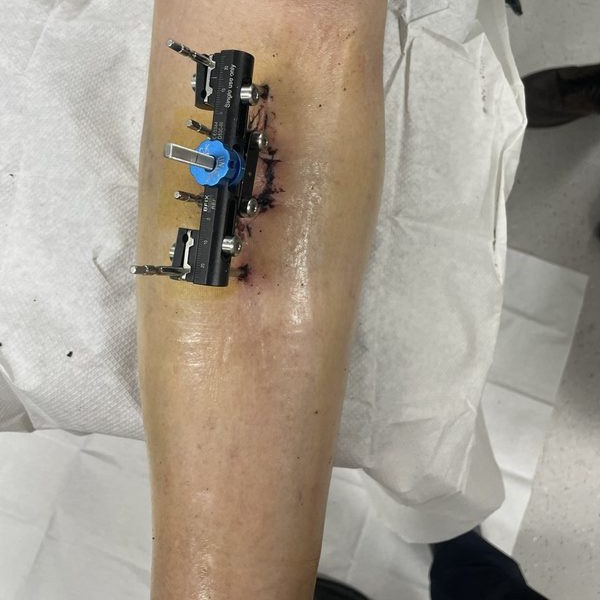
Distraction, then new vessels
TTT applies Ilizarov's principle of distraction osteogenesis to the circulation. Moving the bone segment about a millimetre a day is sensed by the cells lining blood vessels, which respond by releasing growth factors, including VEGF. New capillaries form and perfusion to the foot improves.
It addresses a different problem from bypass or angioplasty. Those restore flow through the larger vessels; TTT builds a new capillary bed, so it can be considered when there is no distal target for bypass, when revascularisation has failed, or alongside it.
I was the first surgeon in the United Kingdom to use the Cybion TTT system, which is purpose-built for controlled, incremental tibial transport. The frame is applied through a small incision, transport runs over several weeks, and the device is then removed.
Before and after transport
Photographs are of my own patients, used with their consent.
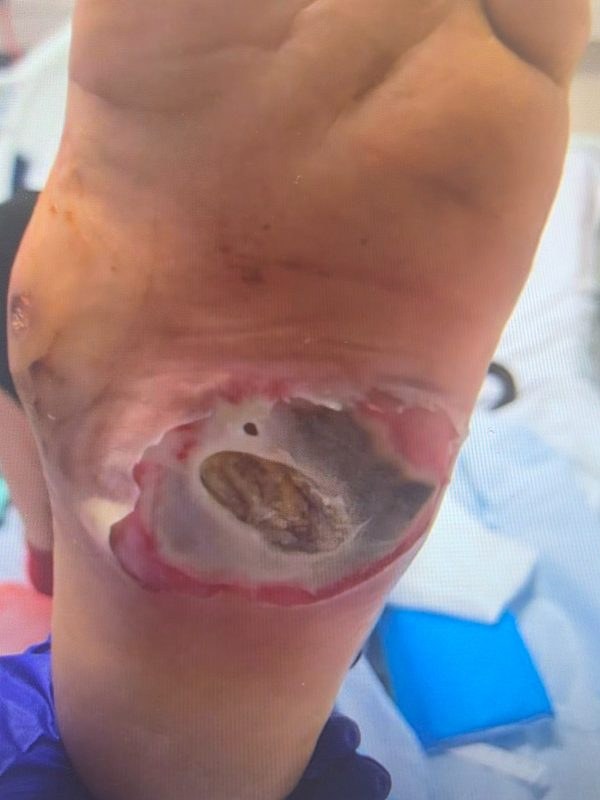
Extensive ulceration of the sole with exposed tissue. Amputation had already been advised.
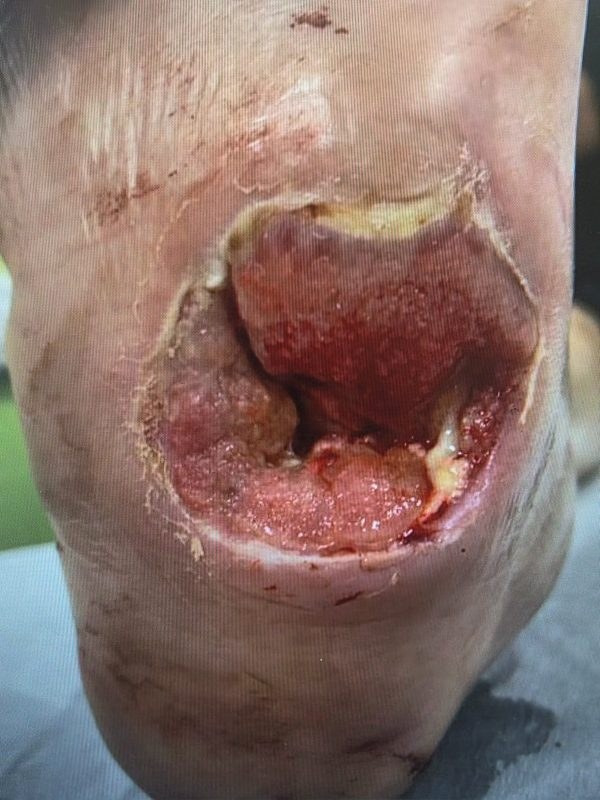
Heel ulceration with dead tissue, in a limb whose circulation could not be improved further.
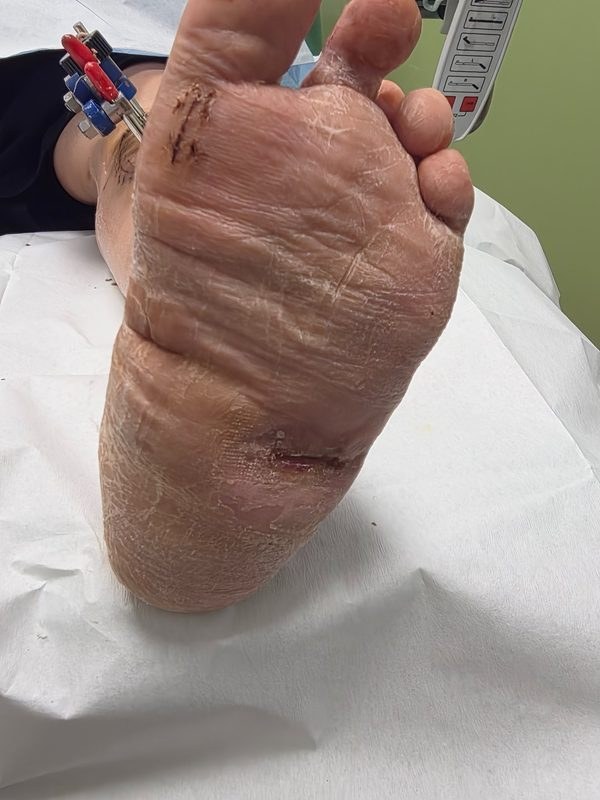
The ulcer healed and the limb was preserved following transverse tibial transport.
What the published work shows
TTT was developed for ischaemic diabetic foot ulcers. The evidence is mostly from series outside the UK, and its use in Charcot reconstruction is new and not yet supported by long-term data. I presented this work at the King's Diabetic Foot Conference in 2025.
Reported healing rates of about 94% with TTT against 68% with conventional treatment in severe diabetic foot ulcers, with a mean healing time of about 4.6 months (Luxon et al., Foot & Ankle International, 2025).
Series report a rise in VEGF and in the ankle-brachial index after transport (Ou et al., Orthopaedic Surgery, 2022; Chen et al., Clinical Orthopaedics and Related Research, 2020).
Small series, short follow-up, and no randomised trial in Charcot reconstruction. It is offered as an adjunct in selected cases, not as a routine step.
Selection
TTT is considered when the circulation cannot be improved further, the ulcer will not heal, and the alternative on the table is amputation. Assessment is with the vascular team, and includes imaging of the circulation and an assessment of whether the bone and skin will tolerate a fixator.